How Start of Autumn Reflects Ancient Chinese Wisdom of Nature
How Start of Autumn Reflects Ancient Chinese Wisdom of Nature
- Introduction
The 24 Solar Terms, a UNESCO intangible cultural heritage, is the precious timekeeping and ecological wisdom system created by ancient Chinese people. As the 13th solar term in the traditional Chinese calendar, Start of Autumn marks the critical transition from scorching summer to cool autumn, symbolizing the alternation of seasons and the transformation of natural rhythms. Beyond a simple date marker, Start of Autumn carries profound ancient Chinese philosophy of “harmony between human and nature”. This article deeply explores how the phenological changes, traditional customs and farming rules of Start of Autumn reflect the ancient people’s unique cognition, adaptation and respect for nature, helping global readers understand the profound cultural connotation behind Chinese traditional solar terms.
- Main Content
- The Essence of Start of Autumn: An Ancient Definition of Natural Rhythm
Start from the solar term origin, interpret ancient natural observation wisdom and consolidate content professionalism.
- Astronomical & Phenological Basis of Start of Autumn
Introduce the astronomical principle of Start of Autumn and the three classic phenological phenomena: cool wind blowing, white dew appearing, and cicadas stopping chirping. Explain how ancient Chinese ancestors summarized seasonal changes through long-term observation of astronomy, climate and creatures, forming a scientific and regular timekeeping system.
- The Core Philosophy of “Following Nature”
Elaborate that Start of Autumn is not only a seasonal division, but also a guide for ancient people’s production and life. The arrival of Start of Autumn reminds people to adjust their living habits and farming arrangements with seasonal changes, reflecting the ancient wisdom of conforming to natural laws rather than conquering nature.
- Tie Qiu Biao”: Adaptive Health Preservation Wisdom
Interpret the traditional custom of gaining weight in autumn. Ancient people adjusted their dietary nutrition according to seasonal temperature changes, making up for physical consumption in hot summer. This custom embodies the ancient people’s healthy living concept of adapting to seasonal climate changes and keeping harmony between human body and nature.
- Farming Wisdom: Start of Autumn’s Guidance for Ancient Agricultural Production
Start of Autumn is a key turning point from crop growth to maturity. Ancient farmers judged the growth cycle of crops according to the solar term, arranged field management, watering and fertilization scientifically, and prepared for autumn harvest in advance, realizing precise planting following natural cycles.
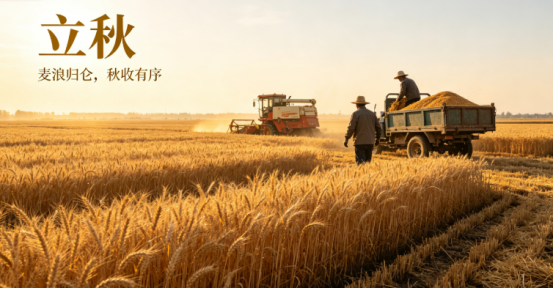
China’s wheat harvesting schedule varies drastically by region, reflecting ancient farmers’ precise mastery of regional natural rhythms. In northern high-latitude and high-altitude agricultural regions including Northeast China, Inner Mongolia, Xinjiang and Gansu, spring wheat is sown in spring and ripens exactly around Start of Autumn. Unlike southern and central China’s winter wheat, which is harvested from May to June, northern spring wheat enters its final mature stage in early August. The Start of Autumn season brings unstable weather with sudden autumn rains and gusty winds. Ripe spring wheat has an extremely short optimal harvesting window: early harvesting leads to unfilled and shrunken grains, while delayed harvesting causes grain shattering, mildew, and germination in rainy weather, wasting a full year’s farming efforts. Therefore, ancient local farmers regarded Start of Autumn as the critical signal for rush harvesting, racing against weather to complete reaping, threshing and grain storage. This traditional farming custom embodies the profound ancient Chinese wisdom of adapting agricultural activities to regional natural laws, adjusting production according to local climate and crop cycles, and respecting the unique rhythm of nature in different regions.
- Modern Value of Start of Autumn’s Ancient Natural Wisdom
- Reference for Modern Eco-friendly Lifestyle
The ancient wisdom of “harmony between human and nature” reflected by Start of Autumn is highly consistent with modern low-carbon, eco-friendly and healthy living concepts, providing valuable traditional experience for modern people’s seasonal health preservation and natural life.
- Inheritance of Traditional Chinese Ecological Culture
As a microcosm of the 24 Solar Terms culture, Start of Autumn witnesses the ancient Chinese people’s profound understanding of nature. It shows the uniqueness and depth of traditional Chinese ecological culture, helping the world understand oriental natural philosophy.
- Core Features of Start of Autumn & Full Summary
Start of Autumn boasts distinct natural and cultural characteristics. In terms of natural phenology, it features cool wind blowing, white dew appearing and cicadas stopping chirping, marking the official transition from hot summer to cool autumn with decreasing temperature, increasing humidity and alternating seasonal rhythms. In terms of human customs and farming, it integrates health preservation wisdom of “Tie Qiu Biao” and “Biting Autumn”, as well as the precious farming experience of autumn wheat rush harvesting. As the connecting node of “summer growth and autumn harvest”, Start of Autumn condenses the ancient people’s long-term observation of astronomy, climate and crop growth. It is not only a simple seasonal division, but also a vivid carrier of Chinese traditional ecological culture. All the living and farming customs derived from Start of Autumn reflect the core ancient Chinese wisdom of observing nature, conforming to nature and achieving harmony between humanity and nature, which still provides valuable life and production guidance for modern society.
What Is Qixi Festival? Origins of China’s Traditional Romantic Festival
Stationery Bulk Order Ready for Shipment from China to USA
Related Article